
Corrugated Box ECT Rating: What It Means and How to Choose the Right Strength
Corrugated boxes are designed to protect products throughout storage, handling, and transportation. However, damaged shipments are not always caused by rough handling. In many cases, the box simply isn’t strong enough for the shipping conditions. Crushed corners, collapsed cartons, and boxes that deform under stacking pressure are often signs that the corrugated board was specified incorrectly.
This is why corrugated boxes are marked with ratings such as 32 ECT, 44 ECT, or 200# Mullen. These numbers indicate how the box has been tested for strength, but they measure different performance characteristics. Choosing the wrong rating can result in unnecessary shipping damage or higher packaging costs than required.
In this article, you’ll learn what ECT ratings mean, how they compare with the Mullen Burst Test, and how to select the right corrugated board based on your products, shipping method, and distribution environment. Understanding these ratings makes it easier to balance packaging performance with material costs.
- ECT (Edge Crush Test) measures how much vertical compression force a corrugated board can withstand before it collapses.
- Higher ECT ratings generally provide better stacking performance.
- 32 ECT is the most common specification for standard shipping cartons.
- 44 ECT and above are often used for heavier products or higher stacking loads.
- If puncture resistance is more important than stacking strength, a Mullen-rated board may be a better choice.
What Is ECT and Why Does It Matter?
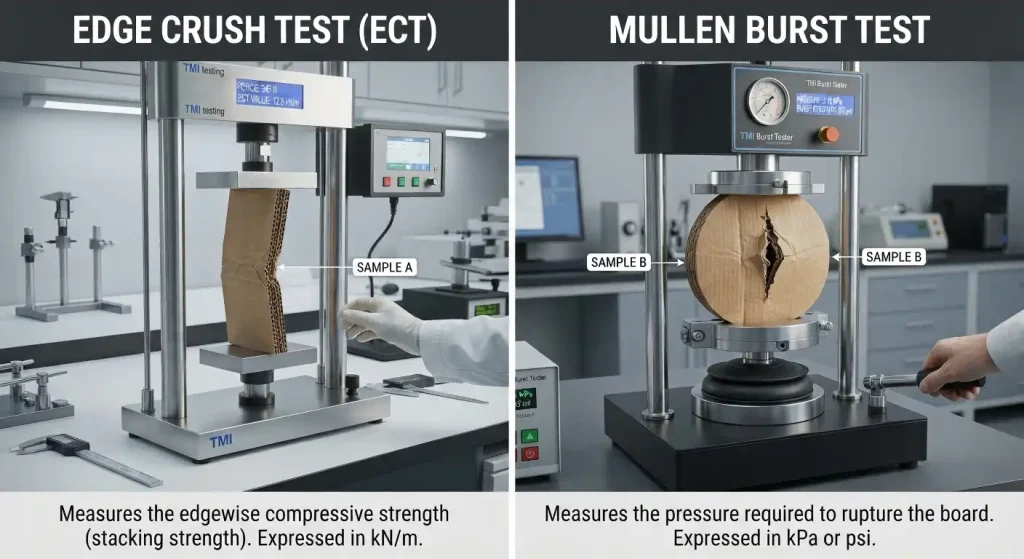
ECT, or Edge Crush Test, measures the edgewise compression strength of corrugated board. Simply put, it indicates how much stacking pressure the edge of a corrugated sheet can withstand before it begins to crush. The result is expressed in pounds per inch (lb/in), so a 32 ECT board is rated to withstand approximately 32 pounds of edge compression per inch under standardized laboratory conditions.
The test follows recognized industry standards, including methods developed by TAPPI and ISO, allowing manufacturers to evaluate corrugated board using consistent testing procedures.
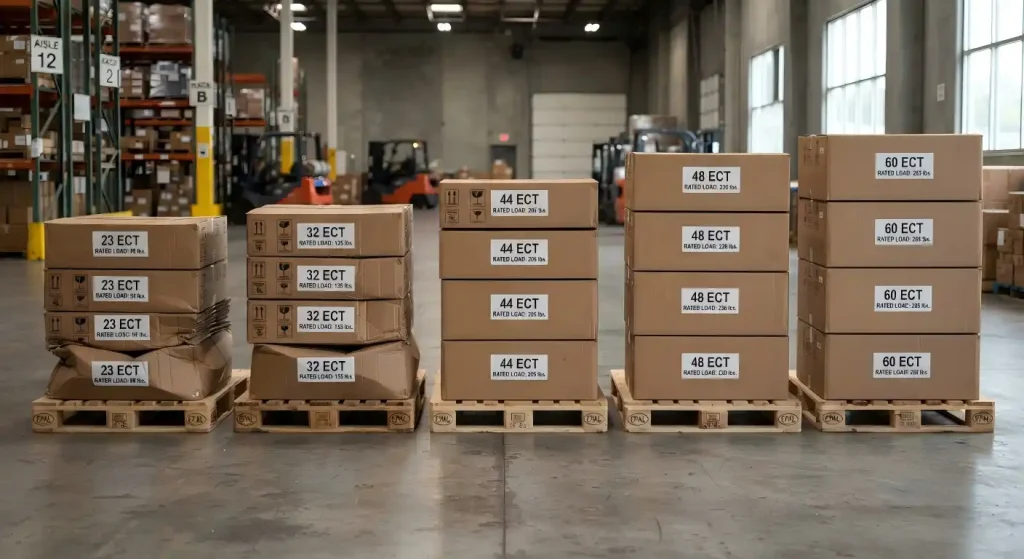
A suitable ECT rating helps cartons maintain their shape during pallet stacking, warehouse storage, and transportation, reducing the risk of box deformation and product damage. At the same time, it helps control packaging costs. Higher ECT ratings generally provide better compression strength, but they also require more material and increase overall packaging expenses. By selecting a board grade that matches actual shipping conditions, businesses can avoid unnecessary costs while still providing the level of protection their products need.
Flute Types and Box Construction
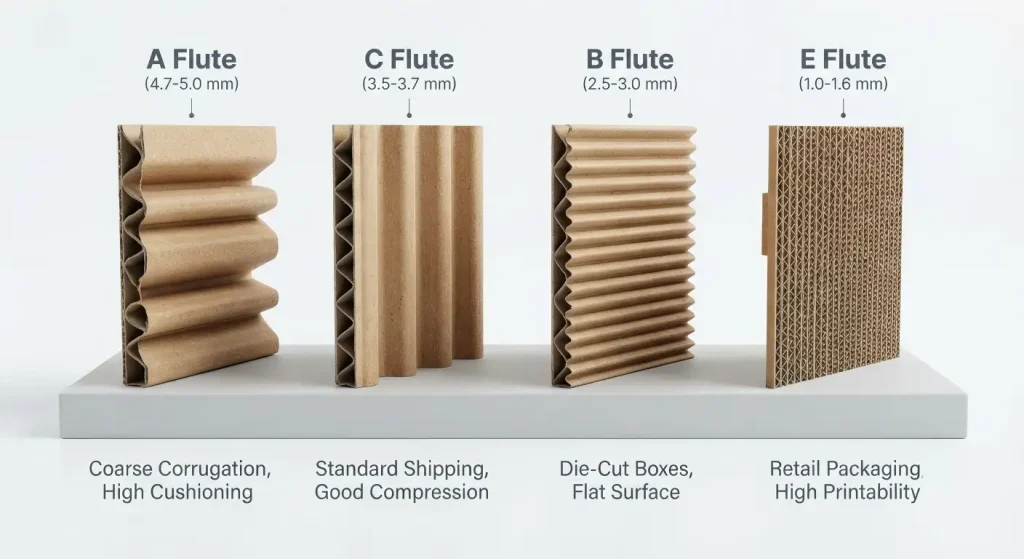
ECT measures the compression strength of corrugated board, but it is only one factor affecting overall box performance. The flute profile—the corrugated medium between the linerboards—also influences cushioning, rigidity, printability, and how well a box performs during transportation.
| Flute Type | Characteristics | Typical Applications |
| A Flute | Excellent cushioning | Fragile products and protective packaging |
| B Flute | Better puncture resistance and smoother surface | Retail packaging and die-cut cartons |
| C Flute | Balanced cushioning and stacking strength | General shipping cartons |
| E Flute | Thin profile with superior print quality | Electronics, cosmetics, folding cartons, branded packaging |
Among these options, C Flute is the most commonly used for shipping cartons because it provides a good balance between cushioning and compression strength. When products are heavier or stacking requirements are higher, manufacturers often choose double-wall corrugated board, combining two flute profiles to improve strength and durability.
Although two cartons may carry the same ECT rating, their real-world performance can still differ because flute profiles affect load distribution, cushioning, and overall package stability. For the best packaging performance, both the ECT rating and board construction should be considered rather than relying on either specification alone.
Common ECT Ratings and Their Typical Applications
ECT ratings are available in several grades to suit different packaging requirements. The right choice depends not only on product weight, but also on factors such as stacking height, transportation method, and overall distribution conditions.
The table below summarizes the most commonly used ECT ratings and their typical applications.
| ECT Rating | Typical Wall Type | Approximate Product Weight* | Common Applications |
| 23 ECT | Single Wall | Up to 20 lb | Lightweight products, inserts, inner packaging |
| 32 ECT | Single Wall | 20–40 lb | E-commerce orders, consumer goods, standard shipping cartons |
| 44 ECT | Single or Double Wall | 40–65 lb | Industrial products, heavier retail goods, higher pallet stacking |
| 48–51 ECT | Double Wall | 65–80 lb | Bulk shipments, automotive components, warehouse distribution |
| 60–90+ ECT | Triple Wall | Over 80 lb | Heavy machinery, export freight, industrial equipment |
*Weight ranges are general guidelines. Actual box performance is also influenced by box dimensions, flute profile, packing method, stacking height, and shipping conditions.
For many businesses, 32 ECT is the standard choice because it provides sufficient compression strength for most everyday shipping applications without using excess material. As product weight and stacking demands increase, 44 ECT or higher grades are often used to provide greater load-bearing capacity.
Some retailers, carriers, and fulfillment programs also specify minimum board strength requirements for certain shipments. Checking these requirements before ordering packaging can help avoid compliance issues and reduce the risk of product damage during transit.
A higher ECT rating does not automatically mean better packaging. The most effective solution is one that matches the actual shipping environment, providing adequate protection while keeping material and shipping costs under control.
ECT vs. Mullen Burst Test: What’s the Difference?
In addition to ECT, corrugated boxes may also carry a Mullen Burst Test rating. Although both are used to evaluate corrugated board, they measure different aspects of box performance.
| Feature | ECT (Edge Crush Test) | Mullen Burst Test |
| Measures | Edge compression strength | Resistance to puncture and bursting |
| Primary Focus | Stacking strength | Surface durability |
| Typical Unit | lb/in | Pounds of burst pressure (#) |
| Best For | Warehouse storage, pallet stacking, freight shipping | Rough handling, puncture risk, parcel delivery |
| Industry Trend | Widely used for shipping cartons | Common in specific industries and applications |
The two tests are designed for different purposes. ECT measures how well a box resists compression when stacked, making it a practical indicator for warehousing, pallet storage, and freight transportation. Mullen, on the other hand, evaluates the amount of pressure required to burst the surface of the board, making it more relevant where puncture resistance is a priority.
As modern supply chains rely more heavily on palletized storage and automated handling, ECT has become the preferred specification for many shipping cartons. Mullen ratings, however, remain valuable for applications where rough handling or sharp objects may increase the risk of punctures.
The following guidelines can help when choosing between the two:
| If your priority is… | Focus on… |
| Long-term warehouse stacking | Higher ECT |
| Palletized freight transport | Higher ECT |
| Greater puncture resistance | Mullen rating |
| Heavy products with high stacking loads | Higher ECT and appropriate board construction |
For many packaging applications, the two ratings complement each other rather than compete. The most suitable specification depends on how the carton will be stored, handled, and transported.
How to Read an ECT Box Stamp
Most corrugated shipping cartons have a box certificate, or box stamp, printed on one of the side panels. This marking identifies the corrugated board used to manufacture the carton and confirms that it meets the required performance standards.
A typical box stamp includes:
- 32 ECT – The minimum edge crush strength of the corrugated board.
- Single Wall or Double Wall – The board construction.
- Manufacturer identification – The company that produced the box.
- Certification information – Confirmation that the box complies with applicable packaging standards.
One of the most common misunderstandings is the ECT rating itself. A 32 ECT stamp does not mean the box can safely carry 32 pounds of product. It means the corrugated board achieved a minimum edge compression strength of 32 pounds per inch under standardized laboratory testing.
The actual load capacity of a finished carton depends on several factors, including its size, board construction, packing method, stacking conditions, and shipping environment. For that reason, the box stamp should be used as a reference for board performance rather than a direct indicator of how much weight the carton can hold.
Factors That Affect Box Strength Beyond ECT
An ECT rating provides a useful indication of compression strength, but it isn’t the only factor that influences box performance. Several other variables should also be considered when selecting corrugated packaging.
- Board grade – The quality and basis weight of the linerboard and corrugated medium affect overall strength and durability.
- Moisture exposure – Corrugated board can lose compression strength in humid conditions, so higher board grades are often specified for shipments exposed to moisture.
- Box dimensions – Larger cartons distribute loads differently from smaller ones, even when they have the same ECT rating.
- Box style – Designs such as RSC cartons, mailer boxes, and die-cut boxes differ in how they support stacking loads and protect the contents.
Another factor is box reuse. Corrugated packaging gradually loses strength after repeated opening, resealing, and handling. Depending on the condition of the carton, its effective compression performance may decline significantly, making reused boxes less suitable for heavy products or high-stacking applications. When product protection is critical, new corrugated cartons generally provide more reliable performance.
How to Choose the Right ECT Rating?
Choosing an ECT rating starts with understanding how the box will be used. Product weight, shipping conditions, storage requirements, and packaging design all influence the level of compression strength needed.
Step 1: Consider Product Weight
Product weight is usually the starting point. Lightweight consumer goods can often be shipped in 32 ECT cartons, while heavier products may require 44 ECT or double-wall construction to provide additional stacking strength.
Step 2: Assess the Level of Protection Needed
Fragile products such as glassware, electronics, or precision components depend on more than the outer carton. Internal cushioning, inserts, and overall package design should be considered alongside the ECT rating to provide adequate protection.
Step 3: Review the Shipping Environment
Think about how the cartons will move through the supply chain. Palletized freight typically places greater emphasis on compression strength, while parcel delivery may expose packages to more frequent handling, drops, and impacts.
Step 4: Consider Storage Conditions
Storage time and stacking height can significantly affect packaging requirements. Long-term warehousing, high pallet stacks, or humid environments may justify selecting a stronger corrugated board.
Step 5: Match the Packaging to the Supply Chain
The chosen board grade should reflect the most demanding stage of distribution rather than the first shipment alone. Products that travel long distances, pass through multiple distribution centers, or remain in storage for extended periods often benefit from additional compression strength, while less demanding applications may not require a higher ECT rating.
There is no single ECT grade that suits every application. Selecting the right rating is a matter of balancing product protection, shipping conditions, and packaging cost.

Don’t Overspec or Underspec Your Packaging
Choosing the highest ECT rating isn’t always the best solution. A stronger board increases material usage, packaging costs, and shipping expenses, while an under-specified carton may fail during storage or transportation, leading to damaged products and unnecessary replacement costs.
The right corrugated box is one that matches your actual distribution requirements. Product weight, shipping method, stacking height, storage conditions, flute profile, and box design all work together to determine the level of protection a package needs. An appropriate ECT rating is only one part of that decision.
At Shine Pack, we help businesses select corrugated packaging based on real shipping conditions rather than one-size-fits-all specifications. Whether you need cost-effective 32 ECT cartons for everyday distribution or heavy-duty double-wall packaging for industrial shipments, our team can recommend a board grade and box construction that balances performance, protection, and cost.
Planning a new packaging project or looking to improve your current shipping cartons? Contact Shine Pack to discuss your packaging requirements and receive a customized solution tailored to your products and supply chain.
FAQ
Is a higher ECT rating always better?
Not necessarily. A higher ECT rating provides greater compression strength, but it also increases material usage and packaging costs. The best choice is the one that matches your shipping and storage requirements.
Is 32 ECT strong enough for shipping?
For many standard shipping applications, yes. A 32 ECT carton is widely used for consumer goods, e-commerce orders, and general freight. However, heavier products or higher stacking loads may require 44 ECT or double-wall construction.
What is the difference between 32 ECT and 44 ECT?
The primary difference is compression strength. A 44 ECT board can withstand greater stacking pressure than a 32 ECT board, making it more suitable for heavier products and demanding transportation environments.
Can 32 ECT replace 200# Mullen?
In many standard shipping applications, 32 ECT is commonly used as an alternative to 200# Mullen. However, because the two tests measure different performance characteristics, they should not be considered direct equivalents. The right choice depends on whether stacking strength or puncture resistance is more important.
Does an ECT rating indicate how much weight a box can hold?
No. An ECT rating measures the compression strength of the corrugated board, not the maximum product weight a finished carton can safely carry. Actual load capacity also depends on box size, board construction, product distribution, packing method, and stacking conditions.