
What Materials Are FDA-Approved for Custom Food Pouches?
When a food brand starts sourcing custom pouches, the packaging structure usually comes first — size, layers, whether it needs a spout or a zipper. FDA compliance tends to surface later, often right before an order gets placed, when someone on the team asks whether the materials are cleared for food contact. The FDA doesn’t approve finished pouches though, it regulates the individual substances inside them.
How the FDA Approves Materials for Food Packaging
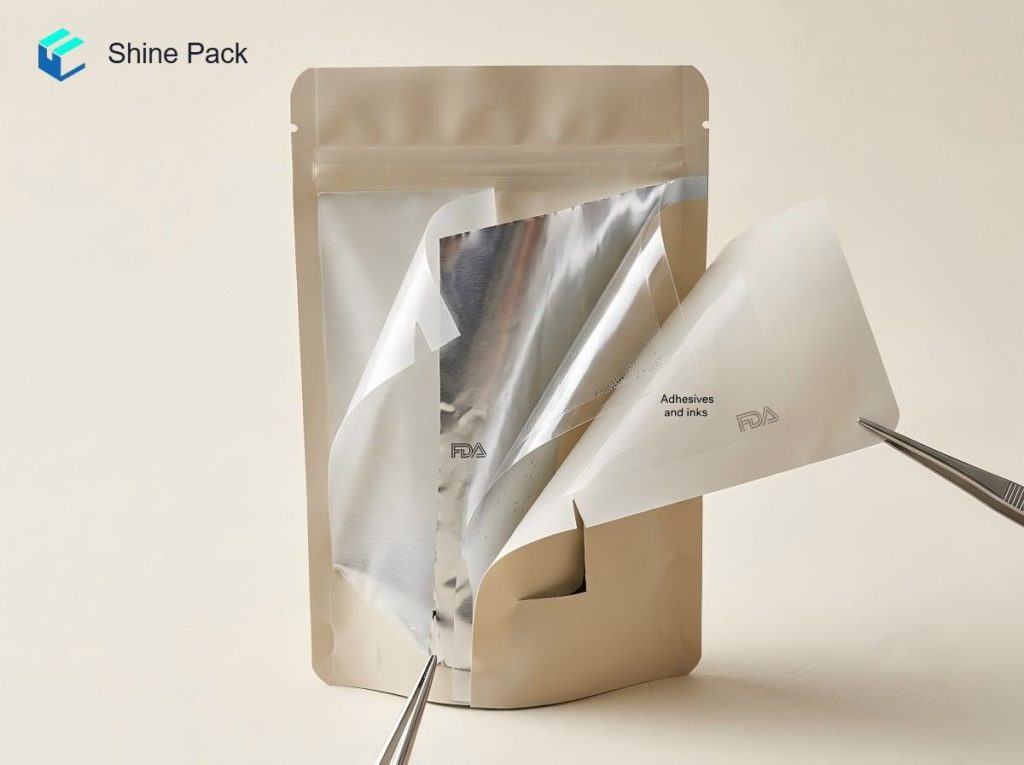
The FDA doesn’t issue a certificate for a stand-up pouch or a spout pouch as a whole. Instead, it evaluates each material that could come into contact with food as a food contact substance including plastics, adhesives, inks, coatings . This distinction matters because a pouch is rarely made from one material. It’s a laminate, usually three to five layers bonded together, and each of those layers is judged on its own terms.
A material can reach compliance through a few different routes. Many common plastics and resins are already listed in 21 CFR Parts 170 through 199, with specific conditions on how they can be used. Others fall under GRAS status, meaning they’re generally recognized as safe based on existing scientific consensus, without needing a new review. Newer substances go through the Food Contact Substance Notification process, where a manufacturer submits safety data and waits for FDA authorization before the material can be sold for that use.
The FDA maintains a public inventory of food contact substances that lists what’s authorized and under what conditions, which is worth checking directly if a supplier’s claims seem vague.
FDA-Approved Materials by Pouch Layer
Since a pouch is built from multiple layers, it helps to look at compliance layer by layer rather than as one blanket question.
- Sealant layer. This is the innermost layer, the one that touches the food and forms the heat seal. Polyethylene (PE) and cast polypropylene (CPP) are the most common choices here, both regulated under 21 CFR Part 177 for olefin polymers. Because this layer has the most direct food contact, suppliers should be able to confirm which specific resin grade they’re using and point to its regulatory listing.
- Barrier layer. This layer keeps oxygen, moisture, and light out, and it’s usually where PET, nylon, EVOH, or aluminum foil come in. PET and nylon are polymers with their own listings under the indirect food additive regulations. Aluminum foil is treated differently — as a largely inert metal, it doesn’t migrate into food the way plastics can, which is part of why it’s a common choice for products with a long shelf life or sensitivity to oxygen, like coffee or dehydrated meals.
- Outer or print layer. This layer usually doesn’t touch the food directly, since it sits on the outside of the laminate. That doesn’t mean it’s ignored in a compliance review, though. Kraft paper and PET are typical here. The bigger compliance question at this stage is usually the ink and adhesive used to print and bond it, not the base film itself.
- Adhesives and inks. Adhesives and inks sit between layers rather than in direct contact with food, but they’re still classified as indirect food additives. Suppliers should be able to document their migration testing or regulatory basis separately from the films themselves. A pouch can use fully compliant film on every layer and still run into trouble if the laminating adhesive wasn’t formulated for food contact use.
Are Compostable and Recycled Pouch Materials FDA Compliant?
Compostable films and recycled content packaging have become more common as brands look for sustainability claims, but neither is automatically FDA compliant just because it’s marketed as eco-friendly.
Recycled plastics, particularly post-consumer recycled PET, often require the recycling process itself to be reviewed by the FDA. In some cases, this results in what’s known as a letter of no objection, confirming that the recycling method produces material pure enough for food contact use under the relevant CFR section. Compostable films made from materials like PLA face a similar situation — the base polymer needs its own food contact clearance, separate from any compostability certification it might carry.
A supplier offering a compostable or recycled-content pouch should be able to produce documentation for both claims.
What Documents to Request From Your Food Pouch Supplier
Before placing a production order, it’s worth requesting a few specific documents rather than taking “FDA compliant” as a standalone claim.
A food contact compliance statement for each layer of the laminate is the baseline — this should reference the specific CFR section or GRAS status the material falls under. A material composition breakdown helps confirm what’s in the structure, particularly for the adhesive and ink systems. Third-party test reports aren’t always necessary for standard materials with established regulatory listings, but they become more relevant for high-heat applications like retort pouches, or for any material claim that isn’t already well documented, such as a new recycled-content film.
It’s reasonable to ask for these documents during the sampling stage rather than after a full production run has shipped. Suppliers who work regularly with food brands usually have this paperwork on file and can send it within a day or two of the request.
“Food-Grade” vs “FDA-Approved”: What’s the Difference?
“Food-grade” and “FDA-approved” get used interchangeably in a lot of supplier conversations, but they don’t mean the same thing. “Food-grade” is a general term suppliers use to describe materials suitable for contact with food, without any regulatory designation behind it. “FDA-approved” or “FDA-compliant” points to something specific, a listing under the CFR, a GRAS determination, or an authorized FCN. A material can be marketed as food-grade without any of that backing it up, especially from suppliers unfamiliar with U.S. import requirements. When a compliance claim matters for market entry, it’s worth asking for the regulatory basis behind it rather than the label alone.
Material selection for a pouch usually comes down to performance first — shelf life, barrier needs, how it holds up during shipping, and how those factors shape the choice between different stand-up pouch structures is worth working through before compliance even enters the conversation. But getting the structure right doesn’t settle the compliance question on its own; the two need to be checked separately.
Checking FDA Compliance Before You Place a Production Order
FDA compliance for a custom food pouch means confirming each layer separately — the sealant film, the barrier layer, the outer film, and the adhesive holding them together. Brands that request this documentation during sampling, rather than after production, avoid most of the delays that come from re-sourcing a layer late in the process.
Compliance and structure tend to get worked out around the same time in practice. Anyone still deciding between pouch formats might find it useful to look at how flexible packaging structures are typically built alongside the material questions raised here, since the two decisions usually inform each other.