
How to Fill Stand Up Pouches? – 3 Methods
In the food, coffee, pet food, and daily chemical industries, Stand-Up Pouches have undeniably become the packaging of choice. They not only maximize shelf presence but also significantly reduce warehousing and logistics costs.
However, as brands scale up production, they often face a core dilemma: How to fill stand up pouches?
As a professional packaging bag and pouch manufacturer, we look beyond just printing and aesthetics; we deeply understand how packaging materials perform on various types of filling machinery. In this article, we will detail the complete stand-up pouch filling process, common equipment, and practical tips to boost your packaging efficiency.
What is a Stand-Up Pouch?
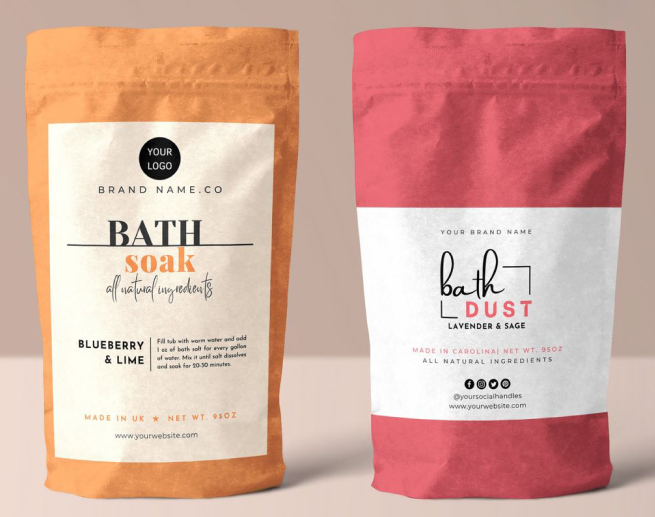
A Stand-Up Pouch (SUP) is a type of flexible packaging featuring a bottom gusset structure that allows it to stand independently for display. Compared to traditional flat pouches, stand-up pouches offer superior shelf visibility and higher space utilization, making them widely adopted across various industries.
Common types of stand-up pouches include:
- Zipper stand-up pouches
- Spouted stand-up pouches
- Aluminum foil stand-up pouches
- Kraft paper stand-up pouches
- High-barrier laminated stand-up pouches
- etc
Depending on product characteristics, businesses must choose the appropriate pouch type and filling method.
Why is Correct Stand-Up Pouch Filling Crucial?
Many view filling as simply putting products into a bag.In actuality, the quality of filling is a critical factor for product quality, package appearance, and general manufacturing costs.
Product Quality Improvement
Precise filling allows to keep the same weight or volume of content, which means compliance with product requirements and consumers’ demands. Besides, proper filling is the key factor in reducing the number of customer complaints and returning products because of the wrong dosing.
Extends Product Shelf Life
Correct filling paired with high-quality sealing effectively minimizes the entry of air, moisture, and contaminants. For food, beverages, and sauces, this reduces the risk of oxidation, moisture absorption, or spoilage, ultimately extending shelf life.
Enhances Packaging Aesthetics
Properly filled stand-up pouches maintain a robust three-dimensional shape, looking neat and premium. Whether displayed online or on retail shelves, beautifully presented packaging naturally attracts consumers and enhances product competitiveness.
Reduces Material Waste
The use of standard filling procedures minimizes instances of product spills, overfills, and improper seals, thereby minimizing waste of pouches and associated costs. This results in better productivity, reduced material and labor costs, and increased economic gains.
How to Fill Stand-Up Pouches?
While designing a stand-up pouch packaging process, the method used to fill the pouches will determine your initial capital investment (CAPEX), throughput, and labor costs. According to the volume of production and level of automation, there are three main filling techniques used in the industry:
Method 1: Manual Filling & Sealing
Manual filling is a rite of passage for many startup brands. It requires no expensive machinery and relies entirely on manual labor, offering extreme flexibility but requiring strict operational discipline. This method is ideal during product development, market testing (Seed Stage), or ultra-small batch customization.
Operational Workflow:
Step 1. Pouch Opening & Gusset Expanding:
In order to get the bottom gusset expanded, both sides of the pouch need to be pinched and pressed gently from the center until the pouch can stand straight on the workstation. In the case of pouches with zippers, they need to be opened manually.
Step 2. Dosing & Filling:
Product will be added manually by using a stainless steel hopper/scoop, and to avoid contamination of product inside, the spout needs to be kept below the line of zipper.
Step 3. Weight Calibration:
The pouch is moved to an electronic bench scale, where operators manually add or remove product to precisely control the target weight.
Step 4. Manual Sealing:
After wiping away any residue from the pouch mouth, the opening is aligned with an impulse sealer (hand or foot-pedal operated). Pressing down the heating arm delivers an instant high-current surge through the heating wire to melt the pouch’s inner PE layer. Hold the pressure for 2-3 seconds to allow it to cool and solidify.
Limitations of This Method:
High Seal Contamination Rate:
When filling powders or liquids, manual operations easily contaminate the zipper track or heat-seal zone. This creates micro-leakers during heat sealing, leading to product oxidation and spoilage.
Efficiency Bottleneck:
A skilled worker can rarely exceed 1,500 pouches per day (8 hours). Furthermore, as fatigue sets in, weight variances inevitably increase.
Method 2: Semi-Automated Pouch Filling
Semi-automated filling is a highly cost-effective “bridge solution.” It delegates the most time-consuming and error-prone step, weighing and dosing, to machinery, while leaving the highly flexible tasks of pouch handling and sealing to human operators. It is perfect for fast-growing small-to-medium enterprises, boutique brands (Growth Stage), and Low-Volume High-Mix production.
1. Core Equipment & Technical Principles
A semi-automated filling setup usually consists of a dosing filler and a continuous band sealer. Based on the state of the material used, the filling method employs distinct filling technologies:
Liquids/Pastes (Semi-Automated Piston Filler): It uses an air cylinder, which regulates the amount per dose through adjustments to piston travel (volumetric filling). This mechanism is fitted with a drip-free pneumatic valve.
Granules/Dry Products (Semi-Automated Vibratory Weigher): The materials are fed from a vibratory pan to the inside of a weigh hopper. The weighing process involves a microprocessor chip that measures the load cell readings in real time, and stops when the targeted weight (such as 250g) is reached.
Powder (Semi-Automated Auger Filler): Servo motors regulate the number of turns made by the vertical auger. Due to the slight variations in powder density, sophisticated equipment will normally have a weight feedback system.
2. Operational Workflow:
The operator physically opens the stand-up pouch and positions it under the discharging head → steps on a foot pedal → which causes the machine to inject/drop the pre-measured product right into the pouch → the operator flattens the top of the pouch and passes it through a continuous band sealer machine that is nearby → the sealer continuously heats, embosses, and cools the pouch using two heating brass blocks on the upper and lower sides.
Why is it the top choice for small-to-medium factories?
If you need to switch from a 100g small pouch to a 1kg large pouch, there are no mechanical arms to adjust or suction cups to replace. You simply update the target weight on the microcomputer panel, and the operator handles the different bag sizes manually.
Method 3: Fully Automated Premade Pouch Packaging
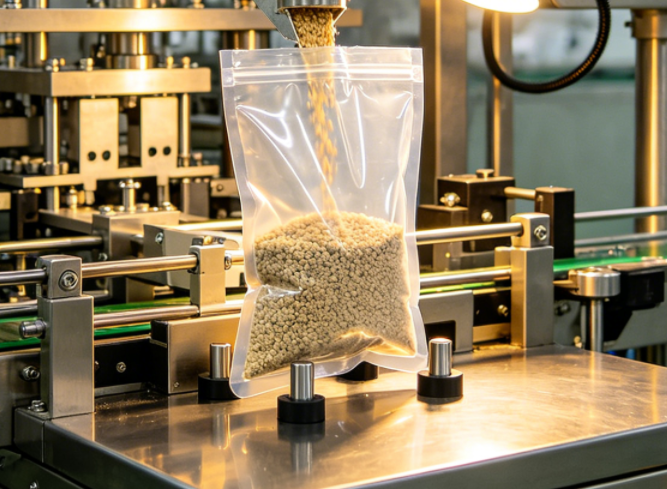
Upon entering large-scale industrial production, skyrocketing labor and management costs make fully automated packaging systems an absolute necessity. Among these, the Premade Pouch Filling Machine is the most compatible equipment for high-quality stand-up pouches.
A complete high-speed automated packaging line typically includes the following core modules:
Z-Bucket Elevator / Vacuum Feeder: Automatically transports tons of raw material to an elevated hopper.
Multi-head Weigher: Typically 10 or 14 heads. It uses combinatorial algorithms to select the bucket combination closest to the target weight within milliseconds, delivering extreme speed and minimizing errors to within $\pm 0.1-0.5\text{g}$.
Rotary Packaging Machine: Generally features 6 or 8 mechanical grippers (stations).
2. Rotary Fully Automatic Operational Workflow (6/8 Station SOP)
The machine cycles at speeds of 30–60 pouches per minute, with each station executing a precise task:
Station 1 (Pouch Feeding): Mechanical grippers precisely pick a single empty stand-up pouch from the vacuum magazine.
Station 2 (Batch Coding): A laser or inkjet printer prints the production date and batch number on the designated area of the pouch.
Station 3 (Pouch Opening & Zipper Unzipping): Vacuum suction cups grip the front and back of the pouch, pulling them apart. Simultaneously, a pneumatic air nozzle blows downward to 100% open the pouch mouth and bottom gusset.
Station 4 (Filling/Dosing): The funnel automatically dives into the pouch mouth, and the multi-head weigher drops the product. This station often features bottom vibration (Settling) to ensure the product settles properly, leaving adequate headspace.
Station 5 (Pre-seal Cleaning & Primary Sealing): A dust extraction device vacuums away powder residues in the seal area (or injects nitrogen gas for deoxygenation), followed by the closure of the first heat-seal bar.
Station 6 (Secondary Sealing & Cooling): A second heat-seal bar applies premium grid or horizontal textures. A water-cooled block then cools the seal to prevent the aluminum foil from wrinkling. The finished product then drops onto a discharge conveyor.
Limitations & Technical Requirements:
Stringent Pouch Quality Requirements: Automated mechanical arms demand strict pouch stiffness, flatness, and anti-blocking properties at the pouch mouth. If low-grade, overly thin, or statically bonded pouches are used, the machine can fail to pick up pouches or fail to fully open the zipper, causing frequent line stoppages.
Summary: Direct Comparison of the Three Filling Methods
| Comparison Dimension | Manual Filling | Semi-Automated Filling | Fully Automated Packaging |
| Initial Equipment Investment | Extremely low (a few hundred RMB) | High cost-performance (several thousand to 20K RMB) | Expensive (hundreds of thousands of RMB) |
| Weight Accuracy | High variance; prone to overfilling or underfilling | Extremely high (utilizes professional load cells) | Extremely high (microcomputer-controlled with auto-correct feedback) |
| Seal Aesthetics | Prone to wrinkling; occasional weak seals | Good (continuous sealing; flat with embossed textures) | Perfect (industrial-grade sealing; exceptionally beautiful) |
| Space & Staffing Requirements | 1 person, 1 table suffices | 1-2 people; requires a few square meters of fixed space | 1 operator to monitor; requires an independent workshop & 3-phase power |
| Core Pain Points | Low efficiency; high dust; easily contaminates seals | Speed is limited by human manual dexterity | Tedious and time-consuming mechanical adjustments during size changeovers |
Which Method Suits Your Business Best?
Go for Manual Packaging if your production level is less than 500 pouches and you have reached the cash recovery stage, provided that the sealing of pouches is kept very clean.
Go for Semi-Automated Filling Line if your production level ranges from 2,000 to 8,000 pouches per day and you are experiencing bottlenecks in terms of manual weighing or weighing accuracy. It provides the greatest ROI.
Go for Fully Automated Premade Pouch Line if one SKU is producing more than 15,000 pouches per day.