Coffee Bag Sizes: Which Size Is Right for Your Brand?
Choosing the right packaging bags is just as important for coffee roasters and coffee shop owners as the roasting process itself. The right coffee bag size not only protects your beans, but also directly affects your shipping costs, shelf appeal, and overall consumer experience.
However, first-time coffee packagers often find themselves confused: What is the difference between a 12 oz flat-bottom bag and an 8 oz stand-up pouch? How do you convert the volume between whole beans and ground coffee?
In this ultimate guide, we will break down everything you need to know about coffee bag sizes to help your brand find the perfect match.
Common Coffee Bag Sizes and Capacities
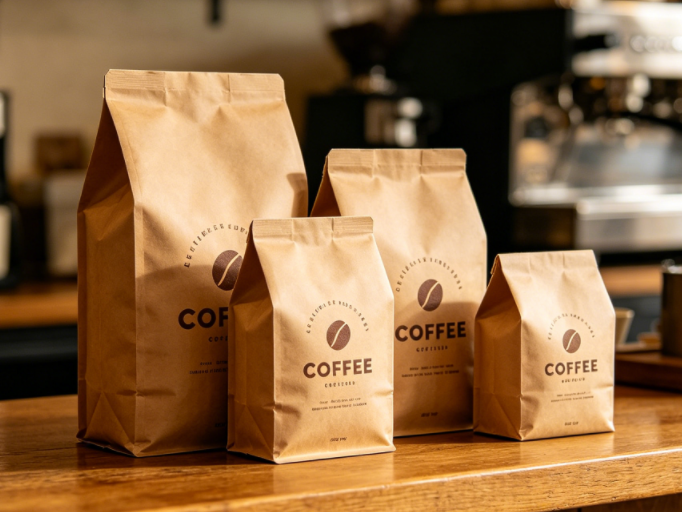
Before diving into the technical details, let’s take a look at the packaging engineering standard table below to get a clear overview of the most common coffee bag sizes and coffee bag dimensions:
| Label Size (Capacity) | Common Physical Dimensions (W x H + Gusset / mm) | Weight (g) | Weight (oz) | Estimated Cups (15g/Cup) | Valve Position (Distance from Top) | Core Commercial Application Scenarios |
| Drip Coffee Single Serve | Outer: 100 x 125 Inner: 74 x 90 | 8g – 12g | 0.3 oz – 0.4 oz | 1 cup | No valve needed | Hotels, offices, portable travel, flavor sampling |
| Sample / Trial Pack | 90 x 150 + 50 | 60g – 100g | 2 oz – 3.5 oz | 4 – 6 cups | 30 mm – 35 mm | Drip coffee gift bundles, new arrival tastings, subscription freebies |
| Specialty Retail | 130 x 200 + 70 | 250g | 8.8 oz | ~16 cups | 40 mm | Mainstream for European/Asian specialty coffee; 2-week golden drinking window for a single person |
| North American Retail Standard | 140 x 220 + 80 | 340g | 12 oz | ~22 cups | 40 mm – 45 mm | Classic “just under a pound” shelf standard size in the US and Canadian markets |
| Medium Stockpile Pack | 160 x 240 + 90 | 500g | 17.6 oz | ~33 cups | 45 mm | Heavy coffee lovers at home, small studios, independent bookstores |
| Commercial / Wholesale | 190 x 320 + 110 | 1kg / 2lbs | 35.2 oz | ~66 cups | 50 mm | Cafe commercial beans, B2B food service wholesale, corporate pantries |
Why Can’t Choose a Coffee Bag by “Weight” Alone?
When customizing coffee packaging, many startup brands make a critical mistake: “I want to pack 250 grams of beans, so I’ll just buy a standard 250g bag.”
As a result, they find they cannot seal the bag once the beans are inside. This happens because the volume and weight of coffee beans are not perfectly equivalent, they are heavily restricted by the roast level and physical form.
Light Roast vs. Dark Roast (Volume Differences by Roast Level)
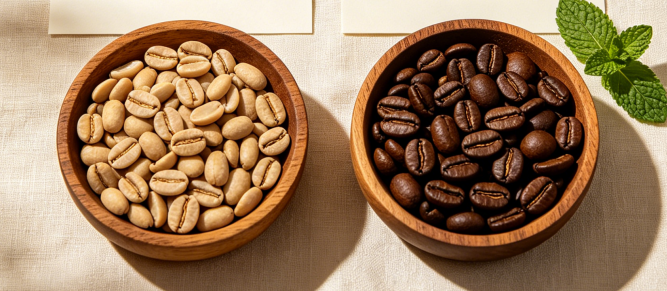
Light Roast: Roasted for a shorter time, keeping more moisture inside the beans with a dense cell structure. Consequently, they have a high density and small volume. 250g of light roast beans looks like a relatively small pile.
Dark Roast: Roasted for a longer time, evaporating almost all moisture. The carbon dioxide causes the bean’s cell structure to expand drastically like popcorn, resulting in low density and large volume.
If your brand focuses on dark roast espresso beans, you must base your custom dimensions on the volume of dark roast beans. You may even need to choose a bag one size larger than standard (e.g., using a 340g volume bag to pack 250g of dark roast beans).
Whole Bean vs. Ground Coffee (Density Differences by Form)
The fact that the whole beans contain lots of air spaces means that the ground coffee has less air spaces in it. As a result, the bulk density of the ground coffee is more by 15% to 20% than the whole beans.
In case, you want to package the whole beans and ground coffee in the same bags for consistency sake in the brand packaging, the ground coffee packaging will be accompanied with huge headspace in the bags. Therefore, you may consider redesigning the graphics on the front side of the bag.
How Bag Types and Materials Affect Coffee Bag Sizes?
Many people assume that if the outer length and width of coffee bags are identical, their internal capacities must be the same too. However, different bag structures and packaging materials directly impact the actual filling space of coffee bag sizes.
Even with identical external measurements, the actual weight of coffee beans a bag can hold can vary significantly.
Flat Bottom Bags
Also known as Box Pouches, flat bottom bags feature a completely flat base and a multi-sided sealed structure. Compared to standard stand-up pouches, they utilize internal space much more efficiently, typically holding about 10% to 15% more coffee beans than a pouch with the same external dimensions. Additionally, flat bottom bags offer better stability on store shelves and easily project a premium brand image, making them increasingly popular among specialty coffee brands.
Stand-Up Pouches
The stand-up pouches commonly have either a K-sealed pouch or round bottom design, which tends to expand naturally at the base as the packaging gets filled. Stand-up pouches are very common in the specialty coffee retail business, as they are best suited for standard volumes such as 250 grams and 500 grams. Their major disadvantage is that their volume efficiency is quite average.
Advantages: Clean appearance, moderate cost, and excellent for e-commerce and retail display.
Side Gusset Bags
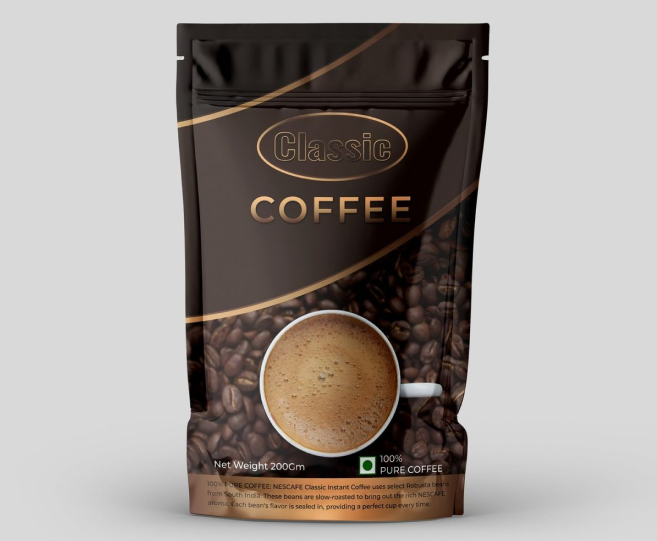
Side gusset bags are primarily used for large-capacity packaging of 1kg and above. Since they do not feature zipper structures and are usually sealed by folding the top with a tin tie, their bag volume can be adjusted much more flexibly. This structure is perfect for the commercial and wholesale markets, and it is highly convenient for box-packing and logistics transportation.
Packaging Materials and Their Hidden Impact on Capacity
Beyond bag structure, the packaging material itself affects the actual filling results of coffee bag sizes.
High-barrier aluminum foil composite materials (PET/AL/PE) are generally stiffer, making the formed bag more stable but keeping the internal space relatively fixed.
Kraft paper composite materials have thicker paper layers, meaning their actual internal capacity is often smaller than standard plastic composite bags of the identical external size.
Eco-friendly alternatives: With the rise of sustainability trends, biodegradable and recyclable materials (like PLA or Mono-PE) are becoming more common. However, these materials have different stretching properties than traditional plastics and are more prone to bag bulging when filled with large capacities. Therefore, you often need to readjust packaging proportions during customization.
3. The Invisible Influence of Micron Thickness on Volume
When discussing coffee bag sizes, there is another dimension that is frequently overlooked besides length, width, and height—material thickness, which is usually measured in microns ($\mu m$).
So, what common size of micron are used for coffee bags?
100 – 120 Micron: Typically used for small stand-up pouches under 250g. The material is softer and easier to open up.
130 – 160 Micron: The industry standard thickness, widely used for 250g to 500g (12 oz) retail flat bottom bags. It offers the perfect stiffness to ensure the bag stands tall on the shelf without collapsing, while providing excellent oxygen and moisture barriers.
160 – 180+ Micron: Mostly used for commercial wholesale side gusset bags of 1kg and above. It provides heavy-duty load capacity to prevent bursting during shipping and stacking.
The thicker the material, the more space its inner folds occupy (especially with multi-layer aluminum foil composites). When customizing small coffee bags with high-micron (thicker) materials, we recommend enlarging the bag dimensions by 3-5mm to ensure your rated weight of coffee beans can be filled with ease.
Commercial Applications and Product Strategies for Different Coffee Bag Sizes
Choosing the right coffee bag size is about more than just “how much coffee to fit.” It is deeply connected to your brand positioning, consumption scenarios, repurchase cycles, and supply chain costs.
Different sizes follow different market logics. Understanding the commercial applications of various coffee bag sizes helps coffee brands formulate more accurate product strategies and packaging solutions.
1. Drip Coffee & Single Serve (8g – 12g)
The 8g–12g small sizes are primarily used for drip coffee bags and cold brew packs. The biggest advantage of this packaging is its portability and ease of brewing, making it perfect for offices, travel, and new user trials. For coffee brands, small-spec products serve as an excellent vehicle to increase trial rates and acquire new customers. To preserve freshness, high-barrier aluminum foil materials are usually used in combination with nitrogen flushing.
2. International Standard Retail (250g / 8.8 oz)
The 250g format happens to be one of the most popular sizes of coffee bags in the current international specialty coffee market. The reason behind this is that this size enables consumers to consume coffee in its optimal freshness period, and hence makes it very appropriate for the specialty coffee industry as well as for micro-lots. In addition, the 250g package size is relatively affordable, giving an incentive to the customers to experiment with various flavors of coffee. This format is often referred to as the ‘Golden Size.’
3. North American Mainstream (340g / 12 oz)
The 340g (12 oz) is currently the prevailing standard in North American markets. Although, traditionally 1 lb (454g) packages were preferred among the western countries because of lower costs, growing prices have pushed the industry to adopt the 12 oz size, which maintains reasonable pricing for the customers. Currently, regardless of whether we refer to Amazon stores or big super markets and/or other independent online retailers, 12 oz has become a common standard in North America.
4. Commercial & Foodservice Wholesale (1kg / 2.2 lbs)
The 1kg packaging is mainly used for coffee shops, restaurant channels, and commercial wholesale markets. Compared to small retail packaging, the 1kg size significantly reduces unit packaging and shipping costs, making it ideal for commercial purchasing. These products typically use a side gusset bag structure equipped with a one-way degassing valve to prevent bag bloating caused by coffee outgassing while extending product freshness.
Conclusion: How to Start Customizing Your Coffee Bags
Deciding which sizes of your coffee bags to choose should be much more than just a straightforward choice regarding the design of packaging materials. Whether it’s 100g trials or 1 kg packages, each size of coffee bags has its unique place on the market and usage.
If you’re thinking about choosing very flexible and easily customizable coffee packaging materials, working with a specialized packaging company such as Shine Pack can provide you with low MOQs without lowering your standards in terms of the quality of your packaging needs.